Ancient World
Feoli collection
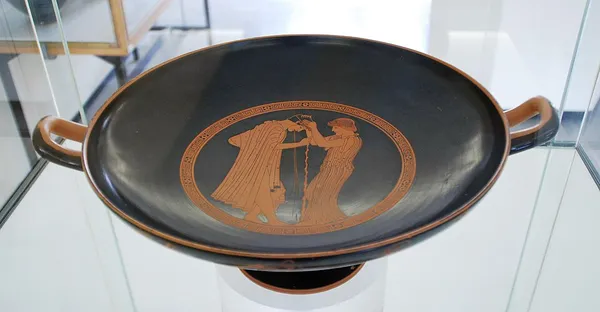
The Feoli collection (German: Sammlung Feoli) is a formerly private collection of ancient art, which is now mostly part of the antiquities collection of the Martin von Wagner Museum in the south wing of the Würzburg Residenz. Agostino Feoli owned an estate which was located in the area of the necropoleis of the ancient Etruscan city of Vulci and carried out several excavations on his lands - like many other estate owners. He carried out two very successful campaigns, one from 1829 to 1831 and another from 1846 to 1847. Unlike most other such excavators, he did not sell many of his finds, but kept them for a personal collection which is still called the Feoli collection in honour of him. The collection was initially publicised by Eduard Gerhard in his Rapporto Vulcente and was published in 1837 by Secondiamo Campanari in his catalogue, Antichi vasi dipinti della collezione Feoli (Ancient Painted Vases of the Feoli Collection). Feoli sold some pieces, but he traded and bought new pieces in his later years. As a result the source of the pieces in the collection which did not appear in the 1837 catalogue is not certain. After this, the collection was considered lost at times. Heinrich Brunn found it in 1865 in Rome and returned it to academic attention. Feoli's heirs had managed to gather the collection together immediately after Feoli's death, but in 1872 they had a financial crisis and had to sell the collection quickly for whatever they could get for it. The classicist Ludwig von Urlichs of the University of Würzburg took note, using Wolfgang Helbig, who was in Rome during Easter 1872, as a mediator. With the help of the then newly invented telegraph, he transmitted the information to Bavaria and quickly convinced the Bavarian ministry of culture, minister Johann von Lutz and the university administration to act in order to acquire the collection for the Wurzberg collection, using the income from a forthcoming exhibition of the art-collector and painter Johann Martin von Wagner. It was more difficult to convince the university senate. It held a vote and decided that the acquisition was unnecessary, since they had already acquired a pretty substantial collection from the bequest of Wagner and some subsequent purchases. Other critics complained that there was no obvious place for storing and displaying the collection.
Also on this shelf
Assyrian lion weights.
Cadder.
See also
Uncatalogued shelfText from Wikipedia; plate via Wikimedia Commons. Text CC BY-SA 4.0; plate freely licensed (see Commons). Source record. Images and catalogue data are reproduced from open-access collections.