Ancient World
Hierapolis
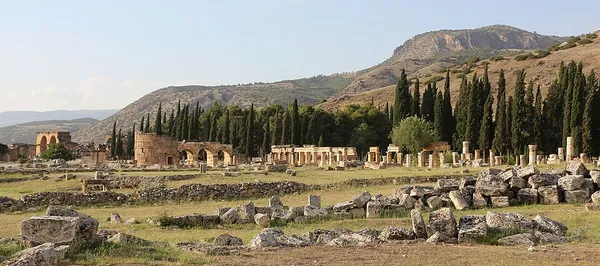
Hierapolis (; Ancient Greek: Ἱεράπολις, lit. "Holy City") was a Hellenistic Greek city in Phrygia, in southwestern Anatolia, Turkey. It was founded in the 3rd century BC, on the site of a Phrygian cult center of the Anatolian mother goddess Cybele, It was famous for its hot springs, its high quality wool fabrics and dyes, and as the birthplace of the Stoic philosopher Epictetus. Its extensive remains are adjacent to modern Pamukkale in Turkey. The hot springs have been used as a spa since at least the 2nd century BCE, with many patrons retiring or dying there as evidenced by the large necropolis filled with tombs, most famously that of Marcus Aurelius Ammianos, which bears a relief depicting the earliest known example of a crank and rod mechanism, and the Tomb of Philip the Apostle. Hierapolis was added as a UNESCO World Heritage Site in 1988. The Italian Archaeological Mission of Hierapolis of Phrygia (MAIER) has operated at the site since 1957 and is currently directed by Grazia Semeraro, Professor of Classical Archaeology at the University of Salento.
Also on this shelf
Caracol.
André Parrot.
See also
Uncatalogued shelfText from Wikipedia; plate via Wikimedia Commons. Text CC BY-SA 4.0; plate freely licensed (see Commons). Source record. Images and catalogue data are reproduced from open-access collections.