Ancient World
Gezer calendar
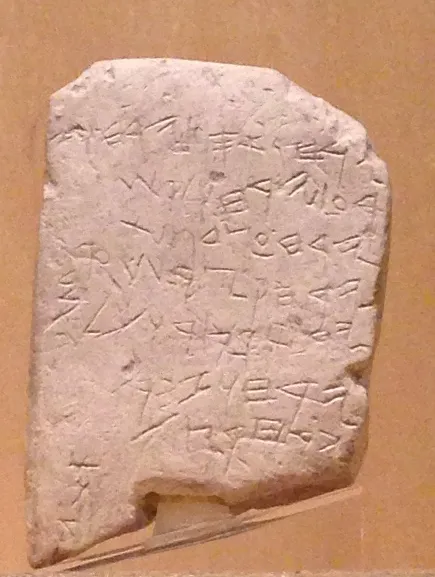
The Gezer calendar is a small limestone tablet with an early Canaanite inscription discovered in 1908 by Irish archaeologist R. A. Stewart Macalister in the ancient city of Gezer, 20 miles west of Jerusalem. It is commonly dated to the 10th century BCE, but the dating is uncertain, because the excavation was not stratified. Scholars are divided as to whether the language is Phoenician or a northern dialect of Hebrew and whether the script is Phoenician, Paleo-Hebrew, or Proto-Canaanite. Aaron Koller surmises that the language is a northern dialect of Hebrew, while Dennis Pardee proposes that it is Phoenician. The inscription is not a formal calendar, as it describes agricultural seasons with imprecise dates, rather than precise divisions of time as would be required for a ritual or bureaucratic calendar. As such, some of the time units comprise two months rather than one, and none are referred to by the month numbers or names known from other sources.
Also on this shelf
History of Syria.
Khirbet Samara.
See also
Uncatalogued shelfText from Wikipedia; plate via Wikimedia Commons. Text CC BY-SA 4.0; plate freely licensed (see Commons). Source record. Images and catalogue data are reproduced from open-access collections.