Ancient World
History of Palestine
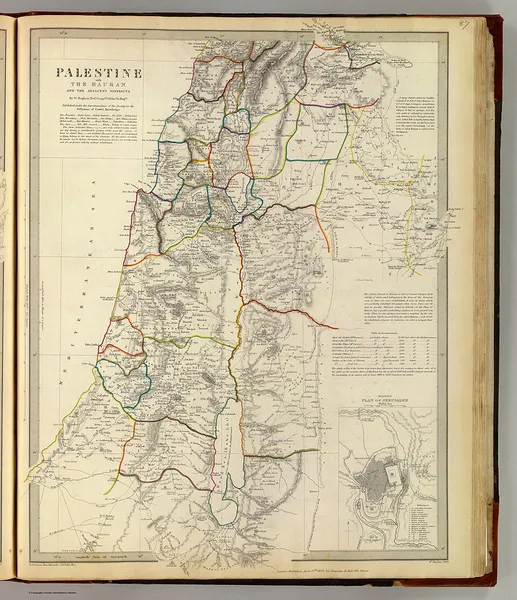
The region of Palestine is part of the Levant, a land bridge between Africa and Eurasia that has traditionally served as the "crossroads of Western Asia, the Eastern Mediterranean, and Northeast Africa". Lying to the west of the Jordan Rift Valley, Palestine is, in tectonic terms, located in the "northwest of the Arabian Plate". A crossroads for religion, culture, commerce, and politics, Palestine was among the earliest regions to see human habitation, agricultural communities and civilization. In the Bronze Age, the Canaanites established city-states influenced by surrounding civilizations, among them Egypt, which ruled the area in the Late Bronze Age. During the Iron Age, the kingdoms of Israel and Judah, emerged in the interior, while kingdoms belonging to Philistia and Phoenicia ruled the Palestinian coast. The Assyrians conquered the region in the 8th century BCE, then the Babylonians c. 601 BCE, followed by the Persian Achaemenid Empire that conquered the Babylonian Empire in 539 BCE. Alexander the Great conquered the Persian Empire in the late 330s BCE, intensifying Hellenizing influences. In the late 2nd-century BCE Maccabean Revolt, the Jewish Hasmonean Kingdom conquered most of Palestine; the kingdom subsequently became a vassal of Rome, which annexed it in 63 BCE. Roman Judea was troubled by Jewish revolts in 66 CE, so Rome destroyed Jerusalem and the Second Jewish Temple in 70 CE. In the 4th century, as the Roman Empire adopted Christianity, Palestine became a center for the religion, attracting pilgrims, monks and scholars. Following Muslim conquest of the Levant in 636–641, ruling dynasties succeeded each other: the Rashiduns; Umayyads; Abbasids; the semi-independent Tulunids and Ikhshidids; Fatimids; and the Seljuks. In 1099, the First Crusade resulted in Crusaders establishing of the Kingdom of Jerusalem, which was reconquered by the Ayyubid Sultanate in 1187. Following the invasion of the Mongol Empire in the late 1250s, the Egyptian Mamluks reunified Palestine under its control, before the region was conquered by the Ottoman Empire in 1516, being ruled as Ottoman Syria until the 20th century largely without dispute. Zionism emerged in as a coherent political project in the late 19th century.
Also on this shelf
Coffin Stone.
Calixtlahuaca.
See also
Uncatalogued shelfText from Wikipedia; plate via Wikimedia Commons. Text CC BY-SA 4.0; plate freely licensed (see Commons). Source record. Images and catalogue data are reproduced from open-access collections.