Ancient World
Erechtheion
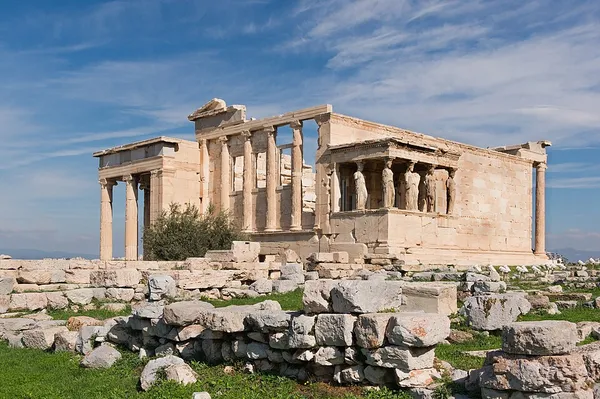
The Erechtheion (, latinized as Erechtheum ; Ancient Greek: Ἐρέχθειον, Modern Greek: Ερέχθειο) or Temple of Athena Polias is an ancient Greek Ionic temple, on the north side of the Acropolis, Athens, that was primarily dedicated to the goddess Athena. The iconic Ionic building, which housed the statue of Athena Polias, has in modern scholarship been called the Erechtheion (the sanctuary of Erechtheus or Poseidon), in the belief that it encompassed two buildings mentioned by the Greek-Roman geographer Pausanias: the Temple of Athena Polias; and the Erechtheion. Whether the Erechtheion referred to by Pausanias and other sources is indeed the Ionic temple or an entirely different building has become a point of contention in recent decades, however, with various scholars ruling out that Athena and Erechtheus were worshipped in a single building. Alternative suggested locations of the true Erechtheion include the structures on the Acropolis conventionally identified as the Arrephorion, the Sanctuary of Zeus Polieus, the Sanctuary of Pandion, and the Dörpfeld foundations. Although scholars have not yet reached consensus on this issue, the building has continued to be referred to conventionally as the Erechtheion. In official decrees, the Ionic building is referred to using a neutral formula: "... το͂ νεὸ το͂ ἐμ πόλει ἐν ο͂ι τὸ ἀρχαῖον ἄγαλμα" ("the temple on the Acropolis within which is the ancient statue"). In other instances it is referred to as the Temple of the Polias. The joint cult of Athena and Poseidon-Erechtheus appears to have been established on the Acropolis at a very early period, and they were even worshipped in the same temple as can, according to the traditional view, be inferred from two passages in Homer and also from later Greek texts. The extant building is the successor of several temples and buildings on the site. Its precise date of construction is unknown; it has traditionally been thought to have been built from c. 421–406 BCE, but more recent scholarship favours a date in the 430s, when it could have been part of the programme of works instigated by Pericles. The Erechtheion is unique in the corpus of Greek temples in that its asymmetrical composition does not conform to the canon of Greek classical architecture.
Also on this shelf
Alauna, France.
Besséʼ.
See also
Uncatalogued shelfText from Wikipedia; plate via Wikimedia Commons. Text CC BY-SA 4.0; plate freely licensed (see Commons). Source record. Images and catalogue data are reproduced from open-access collections.