Ancient World
Hellenistic Palestine
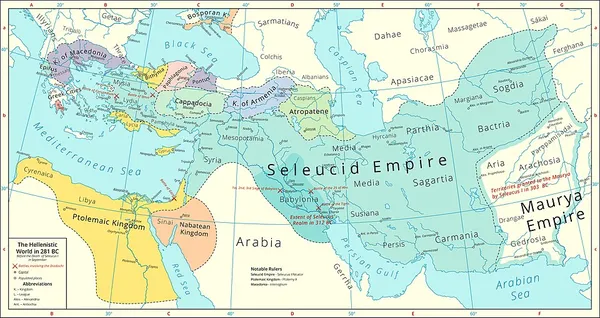
Hellenistic Palestine is a term used to discuss the history of the region of Palestine during its Hellenistic period from 333 BCE to 63 BCE, when Achaemenid Syria was conquered by Alexander the Great and subsumed into his growing Macedonian empire. It includes the history of Hellenistic Judea, which may have still been a province among others, as well as what some scholars refer to as the Land of Israel (Judea, Samaria and the Galilee) though the written material on the provincial organization for this period is scant. Numismatic evidence shows that there were several important poleis that served as important centers under Achaemenid rule and retained minting rights under Hellenistic rule. These include the coastal centers of Ascalon, Gaza, and Ptolemais, as well as to a lesser degree, Demetrius-by-the-sea (possibly the same as Strato's Tower), and for very local use and distribution Jerusalem, and Samaria. After his death in 323 BCE, Alexander's empire was divided among his generals, the Diadochi, marking the beginning of Macedonian rule over various territories, including Coele-Syria, Phoenicia, and Palestine. This initial period saw numerous conflicts as former generals vied for control, leading to ongoing power struggles and territorial exchanges. Ptolemaic rule began with Ptolemy I Soter taking control of Egypt in 322 BCE and consolidating control over Palestine by 301 BCE due to its strategic significance. Ptolemaic rule brought initial stability and economic prosperity to the region. Ptolemy I and his successor, Ptolemy II Philadelphus brought the Ptolemaic dynasty to its zenith by winning the first and second Syrian Wars, and initiating several large-scale building projects, expanding and fortifying existing and new urban settlements. Despite these successes, ongoing conflicts with the Seleucids, particularly over the strategic region of Coele-Syria and the Palestinian coastal cities led to more Syrian Wars. The peace and stability enjoyed by the local population under Ptolemaic rule were disrupted by these wars, and the region's control fluctuated due to the military campaigns and political maneuvers. Seleucid rule began in 198 BCE under Antiochus III the Great, who, like the Ptolemies, allowed the Jews to retain their customs and religion.
Also on this shelf
Jebel Buhais.
Antinoöpolis.
See also
Uncatalogued shelfText from Wikipedia; plate via Wikimedia Commons. Text CC BY-SA 4.0; plate freely licensed (see Commons). Source record. Images and catalogue data are reproduced from open-access collections.