Ancient World
Golden calf
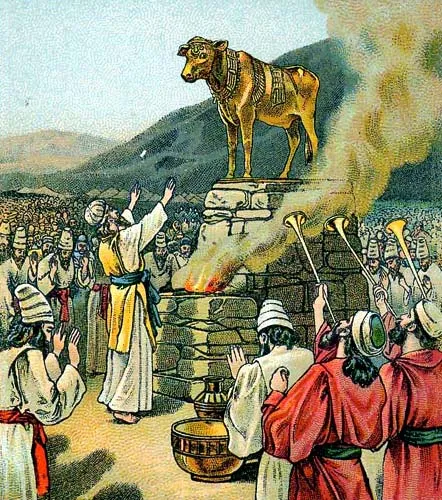
According to the Torah, the Bible, and the Quran, the golden calf (Hebrew: עֵגֶל הַזָּהָב, romanized: ʿēḡel hazzāhāḇ) or, in the Quranic account, the calf (Arabic: عِجْل, romanized: ʿijl) was a cult image made by the Israelites when Moses went up to Mount Sinai. In Hebrew, the incident is known as "the sin of the calf" (Hebrew: חֵטְא הָעֵגֶל, romanized: ḥēṭ hāʿēḡel). It is first mentioned in the Book of Exodus. Bull worship was common in many cultures, and its religious iconography is found throughout the ancient Near East. In Egypt, whence according to the Exodus narrative, the Israelites had recently come, the bull-god Apis was a comparable object of worship, which some believe the Hebrews were reviving in the wilderness. While Egyptian deities like Hathor and Apis have been proposed, as well as the Mesopotamian Sin or Hadad—John Day and other scholars consider Yahweh, the national god of the Israelites, as being associated with or pictured as a sacred bull through the process of religious assimilation and syncretism. Furthermore, there is no tradition that names any other as Israel's deliverer, the festival is dedicated solely to their god, and Samaria Ostraca 41 has a personal name meaning 'calf of Yahweh' or 'Yahweh's calf', as well as the Kuntillet Ajrud inscriptions. Among the Canaanites, some of whom would become the Israelites, the bull was associated with Baal, and widely worshipped as the sacred bull and the creature of El in Ugaritic texts. The accounts of golden calves in Exodus 32 and 1 Kings 12 are considered to be related with structural similarities, and around 13 parallels between the narratives.
Also on this shelf
Domestication of the dog.
Callander.
See also
Uncatalogued shelfText from Wikipedia; plate via Wikimedia Commons. Text CC BY-SA 4.0; plate freely licensed (see Commons). Source record. Images and catalogue data are reproduced from open-access collections.