Ancient World
Etruscan origins
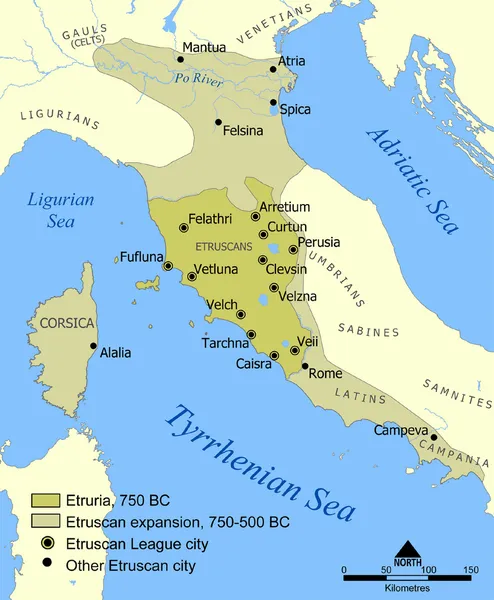
In classical antiquity, several theses were elaborated on the origin of the Etruscans from the 5th century BC, when the Etruscan civilization had been already established for several centuries in its territories, that can be summarized into three main hypotheses. The first is the autochthonous development in situ out of the Villanovan culture, as claimed by the Greek historian Dionysius of Halicarnassus who described the Etruscans autochthonous people who had always lived in Etruria. The second is a migration from the Aegean Sea, as claimed by two Greek historians: Herodotus, who described them as a group of immigrants from Lydia in Anatolia, and Hellanicus of Lesbos who claimed that the Tyrrhenians were the Pelasgians originally from Thessaly, Greece, who entered Italy at the head of the Adriatic Sea in Northern Italy. The third hypothesis was reported by Livy and Pliny the Elder, and places the Etruscans in the context of the Rhaetian people to the north and other populations living in the Alps. The first Greek author to mention the Etruscans, whom the Ancient Greeks called Tyrrhenians, was the 8th-century BC poet Hesiod, in his work, the Theogony. He mentioned them as residing in central Italy alongside the Latins. The 7th-century BC Homeric Hymn to Dionysus referred to them as pirates. Unlike later Greek authors, such as Herodotus and Hellanicus, these earlier Greek authors did not suggest that Etruscans had migrated to Italy from elsewhere. According to prehistoric and protohistoric archaeologists, anthropologists, etruscologists, geneticists and linguists, all the evidence gathered so far points to an autochthonous origin of the Etruscans. Moreover, there is no archeological evidence for a migration of the Lydians or the Pelasgians into Etruria. It was only in the 5th century BC, when the Etruscan civilization had been established for several centuries, that Greek writers started associating the name "Tyrrhenians" with the "Pelasgians" or the "Lydians". There is consensus among modern scholars that these Greek tales are not based on real events.
Also on this shelf
Gethsemane.
Arch of Augustus (Rimini).
See also
Uncatalogued shelfText from Wikipedia; plate via Wikimedia Commons. Text CC BY-SA 4.0; plate freely licensed (see Commons). Source record. Images and catalogue data are reproduced from open-access collections.