Ancient World
Andiron
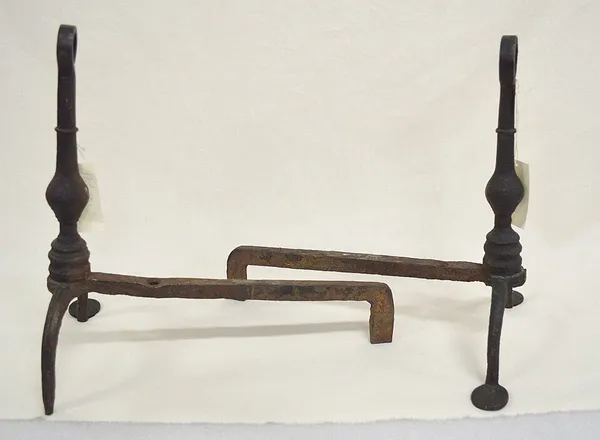
An andiron, firedog, fire-dog, fire dog, iron-dog, or chenet is a bracket support, normally one of a pair, on which logs are laid for burning in an open fireplace, so that air may circulate under the firewood, allowing better burning and less smoke. They generally consist of a tall vertical element at the front, with at least two legs. This stops the logs from rolling out into the room, and may be highly decorative. The other element is one or more low horizontal pieces stretching back into the fireplace and serving to hold the logs off the bottom of the fireplace. An andiron is sometimes called a dog or dog-iron. Before the Renaissance, European andirons, almost invariably made entirely of iron, were of comparatively plain design. Indeed, andirons and firebacks were one of the first types of object commonly made in cast iron (introduced to the West in the 15th century), a trend which in England began in the 1540s: until the nineteenth century cast iron was too brittle for many uses, but andirons carried light loads and this was not a problem. However, from the Renaissance onwards the front vertical element of andirons was increasingly given decorative treatment, and was in a different metal, such as brass, bronze or silver, which allowed casting, hugely increasing the range of decorative possibilities. When metals that could be cast began to be used for the fronts, these ordinary objects of the household received the attention of the artist, and had skill and taste lavished upon them. Thus English late 17th-century andirons often have elaborate flat brass front-pieces, often in openwork and sometimes using enamel for further decoration. By the eighteenth century classical forms with several mouldings, similar to those used for candlesticks and the like, predominate in pieces for the middle classes, and were imitated in the American colonies, often just in iron and rather more simply. Small figures at the front also became popular; in America cast flat "Hessian" soldiers were a long-lasting favourite. In Continental Europe, men such as Jean Berain (1640-1711), whose artistry was most especially applied to the ornamentation of Boulle furniture, sometimes designed them.
Also on this shelf
House of the Vestals Hoards.
Alice Holt Forest.
See also
Uncatalogued shelfText from Wikipedia; plate via Wikimedia Commons. Text CC BY-SA 4.0; plate freely licensed (see Commons). Source record. Images and catalogue data are reproduced from open-access collections.