Ancient World
Inanna
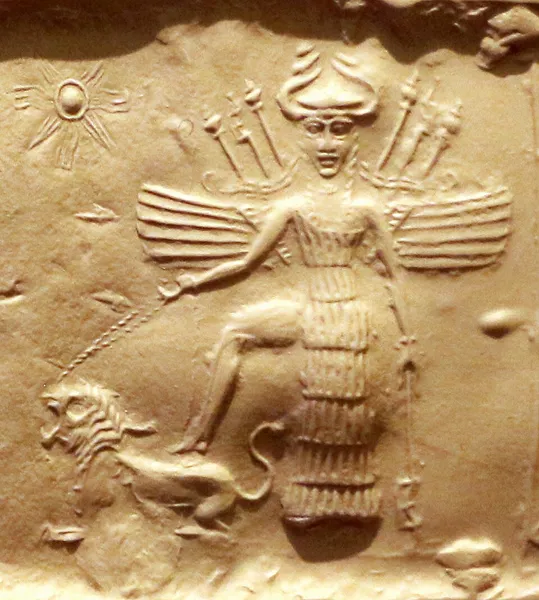
Inanna is the ancient Mesopotamian goddess of war, love, and sex. She is also associated with political power, divine law, sensuality, and procreation. Originally worshipped in Sumer, she was known by the Akkadians, Babylonians, and Assyrians as Ishtar. Her primary title is "the Queen of Heaven". She was the patron goddess of the Eanna temple at the city of Uruk, her early main religious center. In archaic Uruk, she was worshipped in three forms: morning Inanna (Inana-UD/hud), evening Inanna (Inanna sig), and princely Inanna (Inanna NUN), the former two reflecting the phases of her associated planet Venus. Her most prominent symbols include the lion and the eight-pointed star. Her husband is the god Dumuzid (later known as Tammuz), and her sukkal (attendant) is the goddess Ninshubur, later conflated with the male deities Ilabrat and Papsukkal. Inanna was worshipped in Sumer as early as the Uruk period (c. 4000 – 3100 BCE), and her worship was relatively localized before the conquest of Sargon of Akkad. During the post-Sargonic era, she became one of the most widely venerated deities in the Sumerian pantheon, with temples across Mesopotamia. Adoration of Inanna/Ishtar was continued by the East Semitic-speaking peoples (Akkadians, Assyrians and Babylonians) who succeeded and absorbed the Sumerians in the region. The Assyrians elevated her to become the highest deity in their pantheon, ranking close to their own national god Ashur. Inanna/Ishtar is alluded to in the Hebrew Bible and she greatly influenced the Ugaritic goddess Ashtart and later the Phoenician goddess Astarte, who in turn possibly influenced the development of the Greek goddess Aphrodite. Her worship continued to flourish until its gradual decline between the first and sixth centuries CE in the wake of Christianity. Inanna appears in more myths than any other Sumerian deity. She also has a uniquely high number of epithets and alternate names, comparable only to Nergal. Many of her myths involve her taking over the domains of other deities. She is believed to have been given the mes, which represent all positive and negative aspects of civilization, by Enki, the god of wisdom. She is also believed to have taken over the Eanna temple from An, the god of the sky.
Also on this shelf
Culture of Greece.
Burnt House.
See also
Uncatalogued shelfText from Wikipedia; plate via Wikimedia Commons. Text CC BY-SA 4.0; plate freely licensed (see Commons). Source record. Images and catalogue data are reproduced from open-access collections.