Ancient World
Hall of Hewn Stones
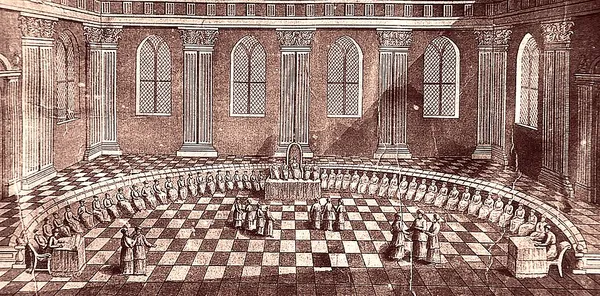
The Hall of Hewn Stones (Hebrew: לִשְׁכַּת הַגָּזִית, romanized: liškaṯ haggāziṯ), also known as the Chamber of Hewn Stone, was the meeting place, or council-chamber, of the Sanhedrin during the Second Temple period (6th century BCE – 1st century CE). The Talmud deduces that it was built into the north wall of the Temple in Jerusalem, half inside the sanctuary and half outside, with doors providing access both to the temple and to the outside. The chamber is said to have resembled a basilica in appearance, having two entrances: one in the east and one in the west. Buildings in the temple complex used for ritual purposes had to be constructed of unhewn stones. (The Torah prohibits the use of hewn stones or those touched by iron for the altar per Ex 20:22, Deut 27:6. Various reasons have been given for the prohibition, among them: the purpose of the Temple is peace, while iron implements are used in war; the Temple lengthens human life while iron shortens it; the hewing of stones is an invitation to carving images in them, violating the prohibition against idolatry; and the sword references the earthly power of Esau, not the spiritual power of Jacob/Israel.) According to the Talmud, the Hall of Hewn Stones is the traditional meeting place of the Great Sanhedrin when it functioned as a court with full sovereign powers including the power to impose criminal penalties. It has been taught; R. Jose said; Originally there were not many disputes in Israel, but one Beth din of seventy-one members sat in the Hall of Hewn Stones, and two courts of twenty-three sat, one at the entrance of the Temple Mount and one at the door of the [Temple] Court, and other courts of twenty-three sat in all Jewish cities. If a matter of inquiry arose, the local Beth din was consulted. If they had a tradition [thereon] they stated it; if not, they went to the nearest Beth din.
Also on this shelf
Al-Walaja.
Dolium.
See also
Uncatalogued shelfText from Wikipedia; plate via Wikimedia Commons. Text CC BY-SA 4.0; plate freely licensed (see Commons). Source record. Images and catalogue data are reproduced from open-access collections.