Ancient World
Archaeology of North Korea
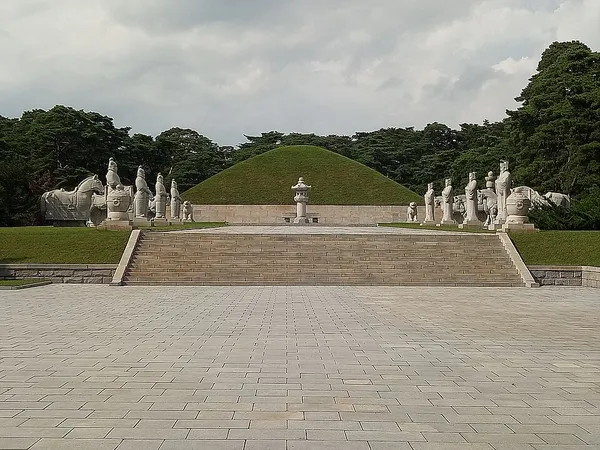
The archaeological record of what is now North Korea stretches back to the first human presence in the peninsula during the Middle Pleistocene. Multiple stone tool traditions existed in Korea during the Late Paleolithic, possibly due to the migration of different groups into the peninsula from the northwest. The Jeulmun period, featuring the introduction of pottery and sedentism, began around 6000 BCE. The Mumun culture, likely spreading into the peninsula from northeast China around the second millennium BCE, is attested by megalithic dolmens and large villages of pit-houses. It saw the introduction of bronzeworking and fully agricultural lifestyle to Korea. In 109 BCE, the Chinese Han dynasty invaded and conquered the state of Wiman Joseon, which had emerged in the area around modern Pyongyang. The Han established four commanderies to govern the area; one of these, Lelang, governed portions of northwestern Korea until it was conquered by the rising Goguryeo kingdom in 313 CE. Goguryeo, characterized by its large royal tombs, dominated northern Korea until it was conquered by Silla in 668. Korea did not develop a systemic tradition of archaeology prior to the practice's introduction into East Asia during the late 19th century. Early antiquarian texts were relatively uninterested in prehistory and artifacts. As Korea fell under the influence of the Empire of Japan in the late 19th century, Japanese archaeologists began to survey the region, seeking to find evidence of the ancestral Yamato people, while Japanese treasure hunters looted Korean archaeological sites. Japanese teams did not generally train Korean students. Following World War II and the division of the peninsula, the European-educated scholars To Yu-ho and Han Hŭng-su became the founding archaeologists of North Korea. After a series of purges and the cessation of most academic work in the country by the late 1960s, a new archaeological academia emerged in the 1970s under the influence of the state ideology of Juche. Modern North Korean archaeology is oriented around Juche thought, incorporating elements of nationalism and Marxist historiography. It sees Korean civilization as having developed independently, rejecting interpretations which emphasize Chinese influence.
Also on this shelf
Chichen Itza.
Frank Kolb.
See also
Uncatalogued shelfText from Wikipedia; plate via Wikimedia Commons. Text CC BY-SA 4.0; plate freely licensed (see Commons). Source record. Images and catalogue data are reproduced from open-access collections.