Ancient World
History of Dublin to 795
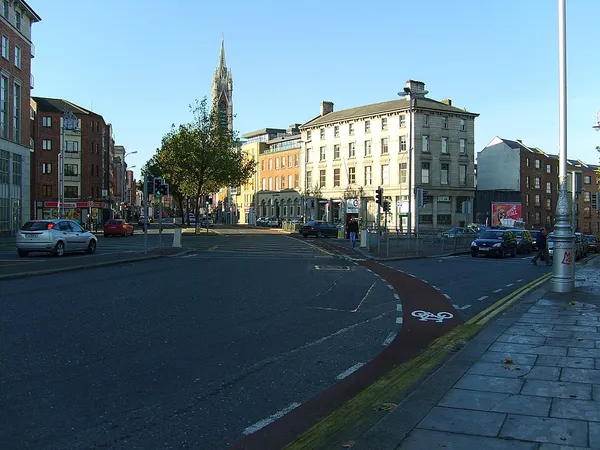
Dublin is Ireland's oldest known settlement.[1] It is also the largest and most populous urban centre in the country, a position it has held continuously since first rising to prominence in the 10th century (with the exception of a brief period in the late 19th and early 20th centuries when it was temporarily eclipsed by Belfast).[2] The historic town grew up on the southern bank of the River Liffey, a few kilometres upstream from the river's outfall into Dublin Bay. The original settlement was situated on a ridge overlooking a shallow ford in the river, which had probably been a regular crossing-point since earliest times. The bedrock underlying the city is calp limestone, a dark shaly sedimentary rock which was once quarried locally and whose mottled grey appearance can still be seen today in some of the city's oldest buildings. Overlying this is a layer of much looser boulder clay of varying thickness. It is no accident that Dublin became the principal city in Ireland. It is located on the island's only significant coastal plain, which not only forms a natural gateway to the rest of the country but also looks out towards the country's closest and most influential neighbour, Great Britain. Furthermore, Dublin Bay provided early settlers with a substantial and easily defended harbour, protected to some extent by treacherous sandbanks, shallows and mudflats, and overlooked by the twin sentinels of Howth Head and Killiney Hill.
Also on this shelf
History of Mesopotamia.
Illyrians.
See also
Uncatalogued shelfText from Wikipedia; plate via Wikimedia Commons. Text CC BY-SA 4.0; plate freely licensed (see Commons). Source record. Images and catalogue data are reproduced from open-access collections.