Ancient World
Ancient Roman pottery
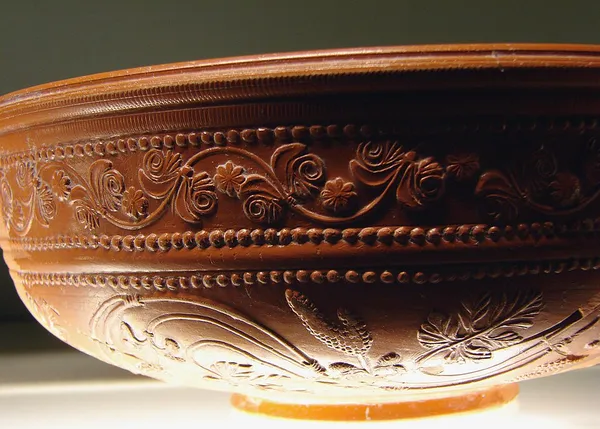
Pottery was produced in enormous quantities in ancient Rome, mostly for utilitarian purposes. It is found all over the former Roman Empire and beyond. Monte Testaccio is a huge waste mound in Rome made almost entirely of broken amphorae used for transporting and storing liquids and other products – in this case probably mostly Spanish olive oil, which was landed nearby, and was the main fuel for lighting, as well as its use in the kitchen and washing in the baths. It is usual to divide Roman domestic pottery broadly into coarse wares and fine wares, the former being the everyday pottery jars, dishes and bowls that were used for cooking or the storage and transport of foods and other goods, and in some cases also as tableware, and which were often made and bought locally. Fine wares were serving vessels or tableware used for more formal dining, and are usually of more decorative and elegant appearance. Some of the most important of these were made at specialised pottery workshops, and were often traded over substantial distances, not only within, but also between, different provinces of the Roman Empire. For example, dozens of different types of British coarse and fine wares were produced locally, yet many other classes of pottery were also imported from elsewhere in the Empire. The manufacture of fine wares such as terra sigillata took place in large workshop complexes that were organised along industrial lines and produced highly standardised products that lend themselves well to precise and systematic classification. There is no direct Roman equivalent to the artistically central vase-painting of ancient Greece, and few objects of outstanding artistic interest have survived, but there is a great deal of fine tableware, and very many small figures, often incorporated into oil lamps or similar objects, and often with religious or erotic themes. Roman burial customs varied over time and space, so vessels deposited as grave goods, the usual source of complete ancient pottery vessels, are not always abundant, though all Roman sites produce plenty of broken potsherds. "Fine" rather than luxury pottery is the main strength of Roman pottery, unlike Roman glass, which the elite often used alongside gold or silver tableware, and which could be extremely extravagant and expensive.
Also on this shelf
Comitium.
American anthropology.
See also
Uncatalogued shelfText from Wikipedia; plate via Wikimedia Commons. Text CC BY-SA 4.0; plate freely licensed (see Commons). Source record. Images and catalogue data are reproduced from open-access collections.