Ancient World
Akanthos (Greece)
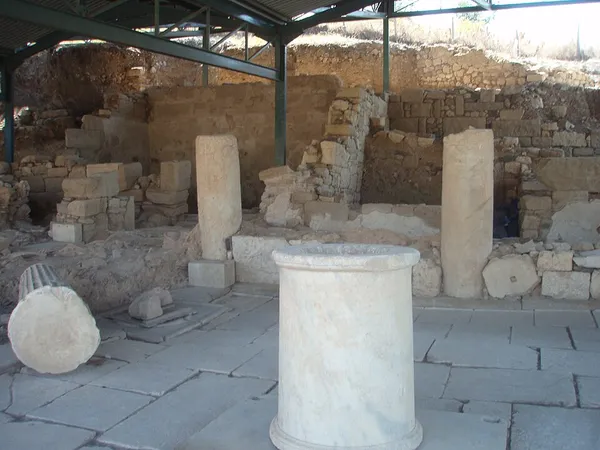
Akanthos (Ancient Greek: Ἄκανθος; Latin: Acanthus) was an ancient Greek city on the Athos peninsula, on the narrow neck of land between the sacred mountain and the mainland, to the northwest of the Xerxes Canal. It was founded in the 7th century BCE as a colony of Andros, itself a colony of Chalcis in Euboea. Chalcidice was multi-cultural. The archaeology of the region suggests that some Hellenes were already there. The site is on the north-east side of Akti, on the most eastern peninsula of Chalcidice. The ancient city extended along a ridge comprising three hills bordering the south-east of modern Ierissos about 0.6 km (2,000 ft) from it. The ridge dominates the landscape. It is terminated on the north by the coastal road (Vasileos Konstantinou) and the beach between Ierissos and its harbor. The modern city is about equal in size to the ancient site, which is now partially wooded. Remains of an 8 m (26 ft) high circuit wall, a citadel, and Hellenistic buildings are visible embedded in the terrain, along with a deserted Byzantine church and two post Byzantine churches. The name selected for the colony is a phytoname, the name of a plant. The plant would most likely be Acanthus mollis, which abounds on the Mediterranean rocky coasts. Pomponius Mela says that it grew on the coast between the River Strymon and Athos. The plant, a thorny, flowering perennial, was known for its medicinal powers. It is the model for the plant design used on Corinthian capitals. The prosperous and successful city in the course of time became a part of the Byzantine Empire. In the 6th century CE the empire declined due to devastation of its population by plague, starting about 541. The peninsula was abandoned by the Hellenes only to be gradually repopulated by Slavs. In the 9th century the Byzantines recovered and reoccupied the peninsula, bringing in Hellenes and Armenians from Asia Minor. They were protected in Roman-style fortified towns called kastra. One of these was Erissos, placed over the site of Akanthos. After it became the site of a Bishopric, Erissos was changed to Ierissos by analogy with Hieros, "sacred." There is an etymology for Erissos as follows. The Marble of Ladiava, an inscription from Ierissos, reports the presence of a large community of Roman merchants, 27 BCE–14 CE.
Also on this shelf
Cave of the Seven Sleepers.
Aquae Cutiliae.
See also
Uncatalogued shelfText from Wikipedia; plate via Wikimedia Commons. Text CC BY-SA 4.0; plate freely licensed (see Commons). Source record. Images and catalogue data are reproduced from open-access collections.