Ancient World
Beni Hasan
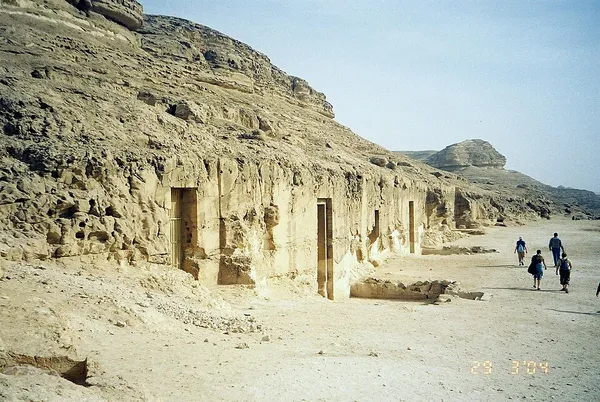
Beni Hasan (also written Bani Hasan, Beni Hassan or Beni-Hassan; Arabic: بني حسن) is an ancient Egyptian funerary site cut into the limestone cliffs that form the eastern edge of the Nile Valley. It lies in Middle Egypt, on the east bank of the Nile about 20 kilometers (12 mi) south of Minya. Its monumental tombs were excavated north of the modern village, approximately halfway up the cliff and overlooking the valley. During the Middle Kingdom, Beni Hasan was the principal cemetery of the sixteenth nome of Upper Egypt, the administrative district known as the Oryx nome. Its capital was the ancient town of Hebenu, identified with Zawyet Sultan, on the east bank of the Nile about 7 kilometers (4 mi) south of Minya; the locality is also known as Zawyet el-Maiyitin, Zawyet al-Amwat and Kom el-Ahmar. The funerary inscriptions also mention Menat Khufu, an Egyptian place-name translated as "the nurse city of Khufu", where some of the nobles buried at Beni Hasan resided, although the settlement has not been securely located. The funerary complex contains burials made between the end of the third and the beginning of the second millennium BC, from the late Old Kingdom to the Middle Kingdom. The monumental tombs of the upper cemetery belong chiefly to the Eleventh and Twelfth Dynasties. At the foot of the slope are the earliest graves of the main group, dated to the end of the Sixth Dynasty or the transition to the First Intermediate Period. Farther down the slope, the lower cemetery comprises about 900 graves, 888 of which were recorded during the excavations of 1902–1904. The upper cemetery contains 39 rock-cut tombs, twelve of which retain painted scenes showing agricultural and craft activities, hunting, games, fighting and the arrival of foreign groups. In tomb BH3 of Khnumhotep II, the decoration includes the procession of the Aamu, fig gathering, and scenes of fishing and fowling in the marshes. South of the cemetery, within a wadi opening east of the village, is an Eighteenth-Dynasty rock-cut temple dedicated to the local goddess Pakhet and built by Hatshepsut. The designation "Cave of Artemis", or Speos Artemidos, derives from the Greek name of the sanctuary and the identification of Pakhet with Artemis.
Also on this shelf
Antiquization.
Djedkare Isesi.
See also
- ▸British Museum Department of the Middle East
- ▸Cathedral of Our Lady of China
- ▸Babylonian Chronicles
Text from Wikipedia; plate via Wikimedia Commons. Text CC BY-SA 4.0; plate freely licensed (see Commons). Source record. Images and catalogue data are reproduced from open-access collections.