Ancient World
Armenia
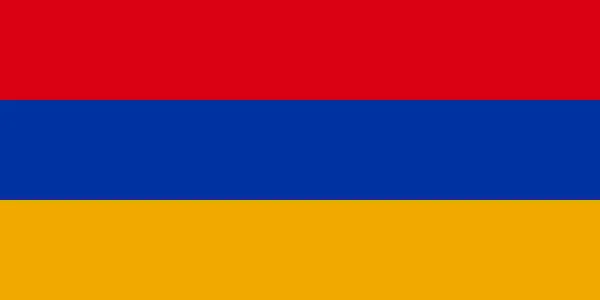
Armenia, officially the Republic of Armenia, is a landlocked country in the Armenian highlands of West Asia. It is a part of the Caucasus region and is bordered by Turkey to the west, Georgia to the north, Azerbaijan to the east, and Iran and the Azerbaijani exclave of Nakhchivan to the south. Yerevan is the capital, largest city and financial center. The Armenian highlands have been home to the Hayasa-Azzi, Shupria, and Nairi peoples. By at least 600 BC, an archaic form of Proto-Armenian, an Indo-European language, had diffused into the Armenian highlands. The first Armenian state of Urartu was established in 860 BC, and by the 6th century BC it was replaced by the Satrapy of Armenia. The Kingdom of Armenia reached its height under Tigranes the Great in the 1st century BC and in AD 301 became the first state in the world to adopt Christianity as its official religion. Armenia still recognises the Armenian Apostolic Church, the world's oldest national church, as the country's primary religious establishment. The ancient Armenian kingdom was split between the Byzantine and Sasanian Empires around the early 5th century. Under the Bagratuni dynasty, the Bagratid Kingdom of Armenia was restored in the 9th century before falling in 1045. Cilician Armenia, an Armenian principality and later a kingdom, was located on the coast of the Mediterranean Sea between the 11th and 14th centuries. Between the 16th and 19th centuries, the traditional Armenian homeland composed of Eastern and Western Armenia was divided between the Ottoman and Persian empires, with control of various regions shifting between the two powers over time. By the 19th century, Eastern Armenia had been conquered by the Russian Empire while most of Western Armenia remained under Ottoman rule. During World War I, up to 1.5 million Armenians were systematically exterminated in the Armenian genocide. Following the Russian Revolution, the First Republic of Armenia declared independence in 1918. By 1920, the state was incorporated into the Soviet Union as the Armenian Soviet Socialist Republic. The Republic of Armenia became independent in 1991 during the dissolution of the Soviet Union. Modern Armenia is a unitary, multi-party, democratic nation-state. It is a developing country and ranks 69th on the Human Development Index as of 2023.
Also on this shelf
Dur-Sharrukin.
Majiayuan site.
See also
Uncatalogued shelfText from Wikipedia; plate via Wikimedia Commons. Text CC BY-SA 4.0; plate freely licensed (see Commons). Source record. Images and catalogue data are reproduced from open-access collections.