Ancient World
Barbarian invasions into the Roman Empire of the 3rd century
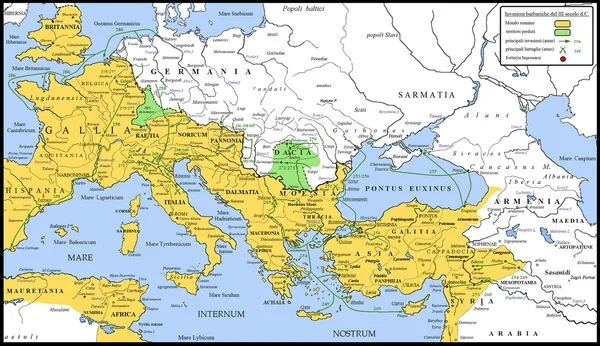
The barbarian invasions of the third century (212–305) constituted an uninterrupted period of raids within the borders of the Roman Empire, conducted for purposes of plunder and booty by armed peoples belonging to populations gravitating along the northern frontiers: Picts, Caledonians, and Saxons in Britain; the Germanic tribes of Frisii, Saxons, Franks, Alemanni, Burgundians, Marcomanni, Quadi, Lugii, Vandals, Juthungi, Gepids and Goths (Tervingi in the west and Greuthungi in the east), the Dacian tribes of the Carpi and the Sarmatian tribes of Iazyges, Roxolani and Alans, as well as Bastarnae, Scythians, Borani and Heruli along the Rhine-Danube rivers and the Black Sea. Since the time of Marcus Aurelius during the Marcomannic Wars (166/167-189), Germanic-Sarmatian tribes had not exerted such strong pressure along the northern borders of the Roman Empire. The growing danger to the Roman Empire of Germanic peoples and Sarmatians was mainly due to a change from previous centuries in the tribal structure of their society: the population, constantly growing and driven by the eastern peoples, needed new territories to expand, or else the weaker tribes would become extinct. Hence the need to aggregate into large ethnic federations, such as those of the Alemanni, Franks and Goths, in order to better attack the neighboring Empire or to defend themselves against the irruption of other neighboring barbarian populations. For other scholars, however, in addition to the pressure of outside populations, it was also the contact and confrontation with the Roman imperial civilization (its wealth, language, weapons, and organization) that prompted the Germanic peoples to restructure and organize themselves into more robust and permanent social systems, capable of better defending themselves or seriously attacking the Empire. Rome, for its part, had been trying since the first century A.D. to prevent the penetration of the barbarians by entrenching itself behind the limes, that is, the continuous line of fortifications extended between the Rhine and the Danube and built precisely to contain the pressure of the Germanic peoples. The breakthrough by the barbarian peoples along the limes was also facilitated by the period of severe internal instability that ran through the Roman Empire during the third century.
Also on this shelf
Beni Hasan.
Bawit.
See also
Uncatalogued shelfText from Wikipedia; plate via Wikimedia Commons. Text CC BY-SA 4.0; plate freely licensed (see Commons). Source record. Images and catalogue data are reproduced from open-access collections.