Ancient World
Hermes Fastening his Sandal
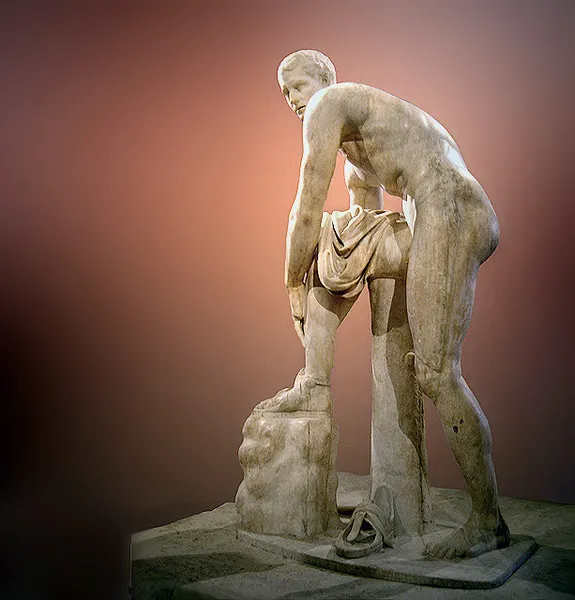
The sculptures of Hermes Fastening his Sandal, which exist in several versions, are all Roman marble copies of a lost Greek bronze original in the manner of Lysippos, dating to the fourth century BCE. A pair of sandals figures in the myth of Theseus, and when the painter-dealer Gavin Hamilton uncovered an example in the swamp ground called the Pantanello at Hadrian's Villa at Tivoli in 1769, he hesitated between calling it a Theseus or a Cincinnatus. Jason's myth also involves a lost sandal. When Augustus Hare saw that sculpture in the Ball Room of Lansdowne House (the Earl of Shelburne having been created Marquess of Lansdowne in 1784), in Berkeley Square, he noted it as "Jason fastening his sandal." The identification with Hermes is based on an identification of the original bronze model as a sculpture of Hermes in the gymnasium and thermae of Zeuxippos in Constantinople, which was described in detail by Christodoros of Koptos in his ekphrasis of the gymnasium as it still remained in Late Antiquity: There was Hermes, of the golden wand. He stood and fastened up the thongs of his winged sandal with his right hand, yearning to rush forth upon his course. His swift right leg was bent at the knee, and on it he rested his left hand, and meanwhile he was turning his face up to heaven, as if he were hearing the commands of his king and father Brunilde Sismondo Ridgway prefers to call the subject The Sandal-Binder or Jason; she notes, that, from the finding sites, the sculpture appears to have been popular in gardens and gymnasia. It was not until 1977, with the discovery of a copy from Perge in Turkey, that scholars were able to securely identify the sculpture as Hermes. This copy held the Kerykeion in the left hand, wore wings on the head and had winged sandals. Judging from the fully lifesize scale of the copies and their generally high quality, the original bronze must have been respected as one of the received masterpieces in the canon of antiquity (Ridgway 1964:120). Four moderately complete Roman marble copies have survived. The Louvre Hermes Fastening his Sandal (illustration) was the first to be discovered.
Also on this shelf
Heraclea Lyncestis.
Gabriele Judica.
See also
Uncatalogued shelfText from Wikipedia; plate via Wikimedia Commons. Text CC BY-SA 4.0; plate freely licensed (see Commons). Source record. Images and catalogue data are reproduced from open-access collections.