Ancient World
Farnese Bull
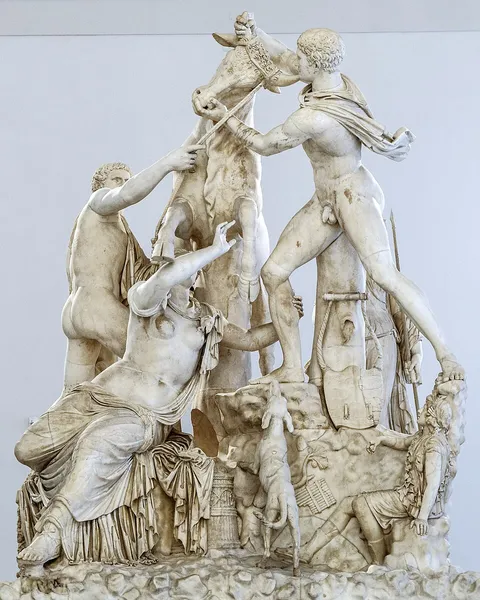
The Farnese Bull (Italian: Toro Farnese), formerly in the Farnese collection in Rome, is a massive and elaborated Roman copy of a Hellenistic sculpture. It is the largest single sculpture yet recovered from antiquity. Along with the rest of the Farnese antiquities, since 1826 it has been in the collection of the Museo Archeologico Nazionale Napoli in Naples, inv. no. 6002, although in recent years sometimes it is displayed at the Museo di Capodimonte across the city. This sculpture is much restored and includes around the base a child, a dog, and other animals that perhaps were not in the original composition if representations in drawings are complete. This sculpture is dated to the Severan period (A.D. 222–235). This colossal marble sculptural group represents an event related in Classical Greek mythology. The subject is the death of Dirce, first wife of Lykos, King of Thebes. She was tied to a wild bull by Amphion and Zethus, the sons of Antiope, who wanted to punish Dirce for the ill-treatment inflicted on their mother. Pliny the Elder mentions what was presumably the prime version of the sculpture as the work of the Rhodian artists Apollonius of Tralles and his brother Tauriscus, stating that the sculpture was commissioned at the end of the second century BC and carved from just one whole block of marble. It was imported from Rhodes as part of the remarkable collection of artwork and sculpture owned by Asinius Pollio, a Roman politician who lived during the years between the Republic and the Principate.
Also on this shelf
Deir el-Bahari.
Aphrodite of Knidos.
See also
Uncatalogued shelfText from Wikipedia; plate via Wikimedia Commons. Text CC BY-SA 4.0; plate freely licensed (see Commons). Source record. Images and catalogue data are reproduced from open-access collections.