Ancient World
Indo-Scythian Kingdom
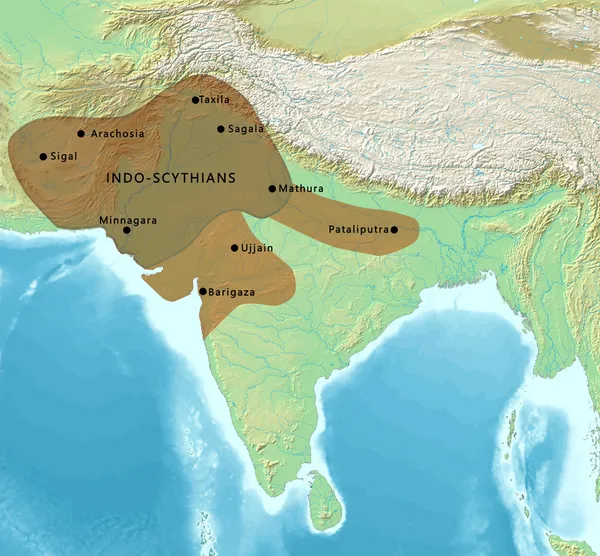
The Indo-Scythians, also known as Indo-Sakas, were a group of nomadic people of Iranic Scythian origin who migrated from Central Asia southward into the present-day regions of Afghanistan, eastern Iran and the northwestern Indian subcontinent (present-day Pakistan and northern India). The migrations persisted from the middle of the second century BCE to the fourth century CE. The first Saka king in the Indian subcontinent was Maues (first century BCE) who established Saka power in Gandhara, the Indus Valley, and other regions. The Indo-Scythians extended their supremacy over the north-western subcontinent, conquering the Indo-Greeks and other local peoples. They were apparently subjugated by the Kushan Empire's Kujula Kadphises or Kanishka. The Saka continued to govern as satraps, forming the Northern Satraps and Western Satraps. The power of the Saka rulers began to decline during the 2nd century CE after the Indo-Scythians were defeated by the Satavahana emperor Gautamiputra Satakarni. Indo-Scythian rule in the northwestern subcontinent ended when the last Western Satrap, Rudrasimha III, was defeated by the Gupta emperor Chandragupta II in 395 CE. The invasion of the northern Indian subcontinent by Scythian tribes from Central Asia, often referred to as the Indo-Scythian invasion, played a significant role in the history of the subcontinent and nearby regions. The Indo-Scythian war was triggered by the nomadic flight of Central Asians from conflict with tribes such as the Xiongnu in the second century B.C., which had lasting effects on Bactria, Kabul and the Indian subcontinent and Rome and Parthia in the west. Ancient Roman historians, including Arrian and Claudius Ptolemy, have mentioned that the ancient Sakas ("Sakai") were nomadic people. The first rulers of the Indo-Scythian kingdom were Maues (c. 85–60 BCE) and Vonones (c. 75–65 BCE).
Also on this shelf
Biblical archaeology.
Arbeia.
See also
Uncatalogued shelfText from Wikipedia; plate via Wikimedia Commons. Text CC BY-SA 4.0; plate freely licensed (see Commons). Source record. Images and catalogue data are reproduced from open-access collections.