Ancient World
"Sappho" fresco (Pompeii)
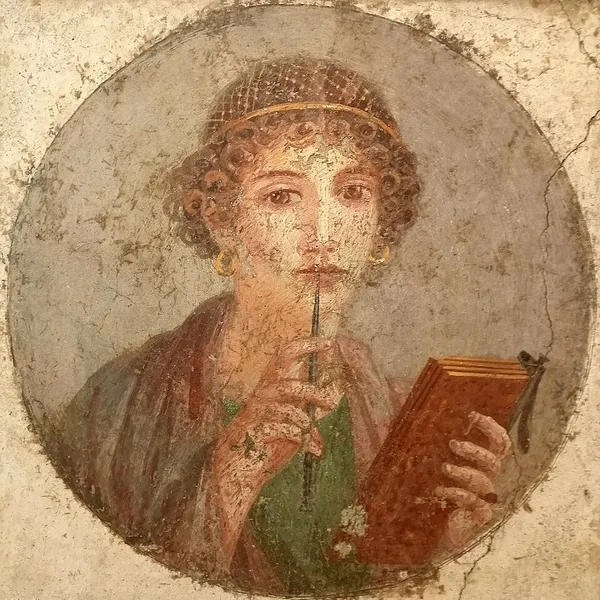
The "Sappho" fresco or Portrait of a Young Woman with Stylus is a fresco dating to the 1st century AD from the city of Pompeii, which was buried during the eruption of Mount Vesuvius in 79 AD. It depicts a finely dressed young woman with a writing tablet and stylus, used in Roman painting to indicate literacy and education. The fresco is ascribed to the Fourth Style of Pompeiian painting and was recovered on 17 May 1760, in a house in the north-west of the city. It is displayed at the National Archaeological Museum, Naples. The portrait was speculatively identified as a depiction of the Greek poet Sappho in the nineteenth century, though no corroborating evidence for this suggestion exists. Most modern scholars treat it as a portrait of an educated, upper-class Pompeiian woman, though it has also been conjectured to be a representation of the Flavian satirist Sulpicia, who was active in the final quarter of the first century AD. The fresco was one of a number of artworks discovered at Pompeii between 1750 and 1760 which were speculatively identified as depictions of Sappho. These sparked renewed interest in the poet in European literature. The fresco was an important influence on the Chinese poet Shao Xunmei, who was inspired to take up poetry after seeing it on a visit to Naples in the early 1920s, and may also have influenced the American performance artist Eva Palmer.
Also on this shelf
Balgonie Castle.
Cambrian Archaeological Association.
See also
Uncatalogued shelfText from Wikipedia; plate via Wikimedia Commons. Text CC BY-SA 4.0; plate freely licensed (see Commons). Source record. Images and catalogue data are reproduced from open-access collections.