Ancient World
Ancient Egypt
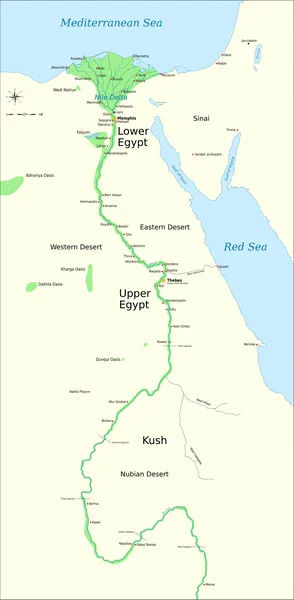
Ancient Egypt was a cradle of civilization concentrated along the lower reaches of the Nile River in the eastern part of North Africa. It emerged from prehistoric Egypt around 3150 BC (according to conventional Egyptian chronology), when Upper and Lower Egypt were united by Menes, who is believed by the majority of Egyptologists to have been the same person as Narmer. The history of ancient Egypt unfolded as a series of stable kingdoms interspersed by the "Intermediate Periods" of relative instability. These stable kingdoms existed in one of three periods: the Old Kingdom of the Early Bronze Age; the Middle Kingdom of the Middle Bronze Age; or the New Kingdom of the Late Bronze Age. The pinnacle of ancient Egyptian power was achieved during the New Kingdom, which extended its rule to much of Nubia and a considerable portion of the Levant. After this period, Egypt entered an era of slow decline. Over the course of its history, it was invaded or conquered by a number of foreign civilizations, including the Hyksos, the Kushites, the Assyrians, the Persians, the Greeks and the Romans. The end of ancient Egypt is variously defined as occurring with the end of the Late Period during the Wars of Alexander the Great in 332 BC or with the end of the Greek-ruled Ptolemaic Kingdom during the Roman conquest of Egypt in 30 BC. In AD 642, the Arab conquest of Egypt brought an end to the region's millennium-long Greco-Roman period. The success of ancient Egyptian civilization came partly from its ability to adapt to the Nile's conditions for agriculture. The predictable flooding of the Nile and controlled irrigation of its fertile valley produced surplus crops which supported a more dense population and thereby substantial social and cultural development. With resources to spare, the administration sponsored the mineral exploitation of the valley and its surrounding desert regions, the early development of an independent writing system, the organization of collective construction and agricultural projects, trade with other civilizations, and a military to assert Egyptian dominance throughout the Near East.
Also on this shelf
American School of Classical Studies at Athens.
Eryx (city).
See also
Uncatalogued shelfText from Wikipedia; plate via Wikimedia Commons. Text CC BY-SA 4.0; plate freely licensed (see Commons). Source record. Images and catalogue data are reproduced from open-access collections.