Ancient World
History of the Vittoriano
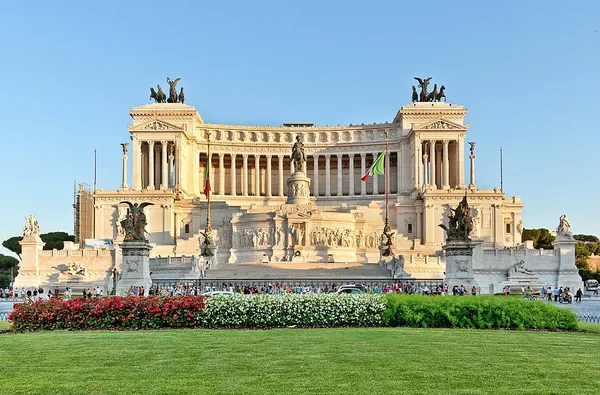
The history of the Vittoriano, an Italian national monument complex located in Rome's Piazza Venezia on the northern slope of the Capitoline Hill, began in 1878 when it was decided to erect in the capital a permanent monument named after Victor Emmanuel II of Savoy, the first king of Italy in the modern era, who brought the process of Italian unification to fruition, so much so that he is referred to by historiography as the “Father of the Fatherland.” In 1880, a first international competition was announced for the construction of the monument, won by Frenchman Henri-Paul Nénot, but this was not followed by an implementation phase of the project. This first attempt was followed in 1882 by a second competition, won by Giuseppe Sacconi, who later became the architect who designed the Vittoriano. The foundation stone of the monument was solemnly laid by King Umberto I of Savoy in 1885. To erect it it was necessary to proceed, between 1885 and 1888, with numerous expropriations and demolitions of pre-existing buildings in the area adjacent to the Capitol, carried out thanks to a precise program established by the government led by Agostino Depretis. The monumental complex was inaugurated by King Victor Emmanuel III of Savoy on June 4, 1911, on the occasion of the events connected with the National Exhibition, during the celebrations of the 50th anniversary of the Unification of Italy. In 1921 part of the monument, the Altar of the Fatherland, originally an altar of the goddess Roma, was chosen to house the remains of the Unknown Soldier, whose body was buried on November 4 in a ceremony attended by a huge crowd. The last completion works took place in 1935, with the construction of the Central Museum of the Risorgimento, which was inaugurated and opened to the public decades later, in 1970. With the advent of fascism (1922) the Vittoriano became one of the stages of the regime led by Benito Mussolini.
Also on this shelf
Chariton the Confessor.
Etowah Indian Mounds.
See also
Uncatalogued shelfText from Wikipedia; plate via Wikimedia Commons. Text CC BY-SA 4.0; plate freely licensed (see Commons). Source record. Images and catalogue data are reproduced from open-access collections.