African Art
Battle of Magdala
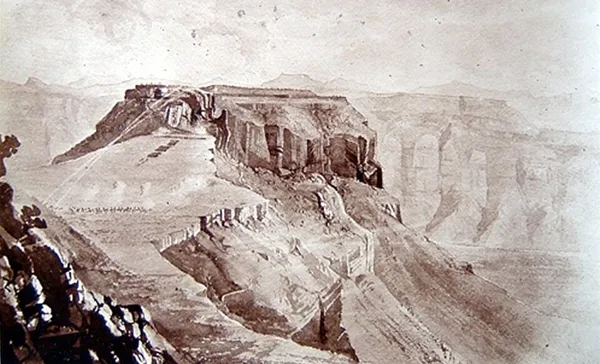
The Battle of Magdala was the conclusion of the British Expedition to Abyssinia fought in April 1868 between British and Abyssinian forces at Magdala, 390 miles (630 km) from the Red Sea coast. The British were led by Robert Napier, while the Abyssinians were led by Emperor Tewodros II. The Battle of Derasge marked a decisive turning point in Ethiopian history, bringing an end to the Zemene Mesafint ('Era of the Princes') and paving the way for the rise of Emperor Tewodros II and the unification of the Ethiopian Empire. Following his victory at the Battle of Derasge and accession to the imperial throne as Tewodros II, the new emperor embarked on an ambitious program of national reform. Determined to unify Ethiopia and assert its independence, he set out to centralize administration, consolidate political power, and establish a modern, professional army to protect the empire from outside threats most urgently from Egypt. His experience during the Battle of Debarki 1848, where his armies suffered heavy losses at the hands of better-trained and better-equipped Egyptian soldiers, had left an indelible mark. It taught Tewodros the imperative of military discipline, high-level training, and modern weapons, which became central to his drive for modernization. Based on his mission of building a united and strong state, Emperor Tewodros II initiated large-scale military reform to update the armed forces in Ethiopia. He established systematic military training, uniform drills, and introduced new ranks such as Aseraleqa (corporal), Hamsaleqa (sergeant), Metoleqa (lieutenant), and Shaleqa (major). His first priority was the establishment of a well-trained, well-disciplined national army equipped with modern weapons. Tewodros, being aware of the technology and military disparity of Ethiopia, specifically following his loss at the Battle of Debarki in 1848, sought to redefine the capability of Ethiopia for defense. Rather than relying on European foreign weapons, he wanted to have local arm production. Toward this end, he enlisted the services of the European great powers most notably Britain for skilled persons and technical knowledge.
Also on this shelf
1174.
1921.
See also
Uncatalogued shelfText from Wikipedia; plate via Wikimedia Commons. Text CC BY-SA 4.0; plate freely licensed (see Commons). Source record. Images and catalogue data are reproduced from open-access collections.