African Art
Cretan school
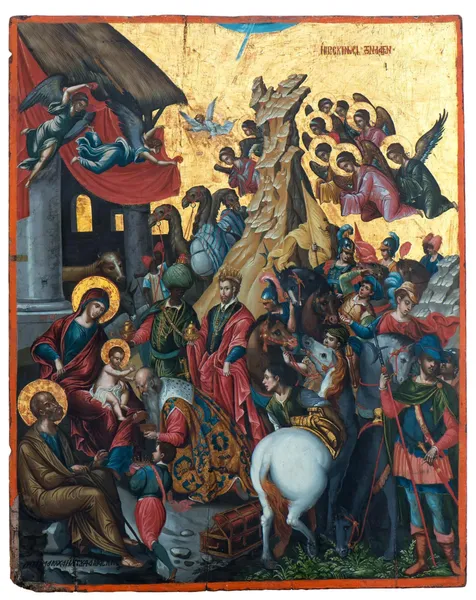
The Cretan school describes an important school of icon painting, under the umbrella of post-Byzantine art, which flourished while Crete was under Venetian rule during the late Middle Ages, reaching its climax after the fall of Constantinople, becoming the central force in Greek painting during the 15th, 16th, and 17th centuries. The Cretan artists developed a particular style of painting under the influence of both Eastern and Western artistic traditions and movements; the most famous product of the school, El Greco, was the most successful of the many artists who tried to build a career in Western Europe, and also the one who left the Byzantine style farthest behind him in his later career. Early painters from Crete included Nikolaos Philanthropinos 1380–1450, Ioannis Pagomenos 1285–1340 and Manuel Fokas. Philanthropinos completed some mosaics in Venice, Italy at St Mark's Basilica in the 1430s. The fathers of the Cretan school are considered Angelos Akotantos, Andreas Pavias and Andreas Ritzos. Some of their works include: Saint Anne with the Virgin, The Virgin Pantanassa and The Crucifixion. Between 1454 and 1526, Crete was saturated with painting workshops, and the number of painters exceeded 145. Some painters, such as Nikolaos Gripiotis, produced mass quantities of unsigned icons for Italian and Greek patrons during the period, while other painters chose to sign their works. Angelos Pitzamanos and Donatos Pitzamanos traveled to Italy, fusing the Cretan style with the School of Otranto in the late 1400s and early 1500s. A popular work completed by Angelos was Madonna of Constantinople. By the mid-1500s, Michael Damaskinos and Georgios Klontzas dominated the century with their incredible works. Some of Damaskinos' works were: Wedding at Cana , Madonna del Rosario, and Beheading of John the Baptist. Some of Klontzas' works were: In Thee Rejoiceth , Triptych of the Last Judgement, and Saint Catherine's Engagement. Both of the painters flourished around the time of El Greco, while Klontzas was recorded assessing one of his works. Another notable painter of the same era was Thomas Bathas, who maintained the Miraculous Icon of the Virgin Mary at St Mark's Basilica but also painted his own version entitled Virgin Nikopoios. His student Emmanuel Tzanfournaris was part of the late Cretan school, and he completed the Virgin of the Passion.
Also on this shelf
1728.
1922 regnal list of Ethiopia.
See also
Uncatalogued shelfText from Wikipedia; plate via Wikimedia Commons. Text CC BY-SA 4.0; plate freely licensed (see Commons). Source record. Images and catalogue data are reproduced from open-access collections.