African Art
Blue in culture
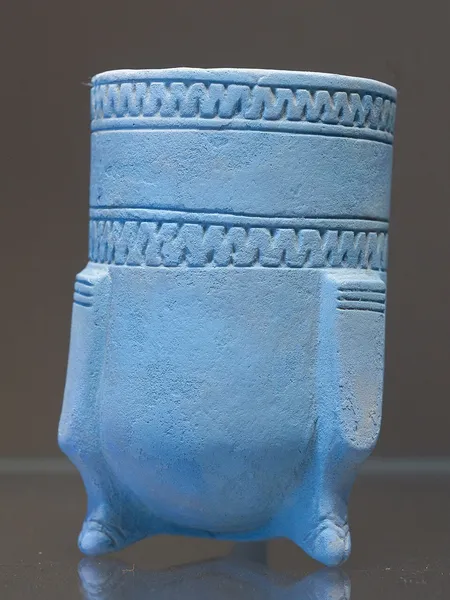
The color blue has been important in culture, politics, art and fashion since ancient times. Blue was used in ancient Egypt for jewelry and ornament. In the Renaissance, blue pigments were prized for paintings and fine blue and white porcelain. In the Middle Ages, deep rich blues made with cobalt were used in stained glass windows. In the 19th century, the color was often used for military uniforms and fashion. As the color that most symbolized harmony, blue was chosen as the color of the flags of the United Nations and the European Union. On 9 December 1955, the Committee of Ministers adopted the Emblem of the Council of Europe selecting the color heraldic azure to represent the blue sky of the Western world. Surveys in the US and Europe show that blue is the color most commonly associated with harmony, faithfulness, confidence, distance, infinity, the imagination, cold, and occasionally with sadness. In US and European public opinion polls it is the most popular color, chosen by almost half of both men and women as their favorite color. The same surveys also show that blue is the color most associated with the masculine, just ahead of black, and was also the color most associated with intelligence, knowledge, calm, and concentration.
Also on this shelf
1766.
Lille 3000.
See also
Uncatalogued shelfText from Wikipedia; plate via Wikimedia Commons. Text CC BY-SA 4.0; plate freely licensed (see Commons). Source record. Images and catalogue data are reproduced from open-access collections.