African Art
Gheza Vida
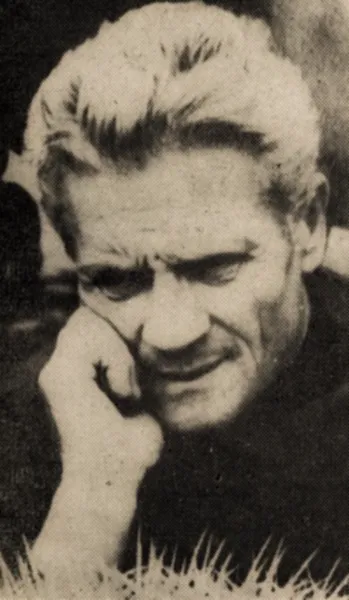
Gheza or Géza Vida, also known as Grigore (Hungarian: Vida Géza; February 28, 1913 – May 11, 1980), was a Romanian–Hungarian sculptor, engraver, industrial worker and communist militant, one of the most renowned artists of Maramureș region. The descendant of ethnic Romanian and Slovak miners, he was born in the Hungarian segment of Austria-Hungary. Raised by his mother after his father's death in World War I, he received financial support from local benefactors, who cultivated his artistic skill, particularly as a woodcarver. A citizen of Romania after the union of 1918, he was forced to drop out of school by economic circumstances, and worked for years in various industries and businesses, while also discovering his passion for beekeeping and gardening. He was drawn into far-left politics during the Great Depression, when he came to be influenced by radical artists such as Alexandru Ziffer, Aurel Popp, Vasile Kazar and Iosif Klein, who also introduced him to avant-garde experimentation. Vida was co-opted into the Union of Communist Youth and subsequently the Communist Party, producing propaganda art for both; this activity led to his temporary arrest in 1932 and 1933. A labor organizer, he helped establish the Artists' Trade Union and its branch in Baia Mare. Having trained as a gunner in the Romanian Land Forces, Vida made repeated attempts at joining the International Brigades fighting in the Spanish Civil War. Though imprisoned and expelled upon illegally crossing the border with Czechoslovakia, he resumed the effort and finally reached Republican Spain in early 1938. He served for a few months under Nicolae Cristea and Valter Roman, before the Brigades were withdrawn from the Battle of the Ebro. Vida survived the retreat into France, surrendering to the National Gendarmerie. Vida moved between French internment camps, finally being sent to Gurs; he also continued to work as a propaganda artist, reaching an international audience. A participant in prisoner revolts before and after the fall of France, he was dispatched as a laborer to Nazi Germany, but eventually made his way to Northern Transylvania. As a Romanian national in Regency Hungary, Vida was under continuous supervision. His studying at the Hungarian School of Fine Arts was interrupted by stints in a labor battalion, though he managed to escape during the Siege of Budapest.
Also on this shelf
History of Nigeria (1500–1800).
Charles Walmesley.
See also
Uncatalogued shelfText from Wikipedia; plate via Wikimedia Commons. Text CC BY-SA 4.0; plate freely licensed (see Commons). Source record. Images and catalogue data are reproduced from open-access collections.