African Art
History of West Africa
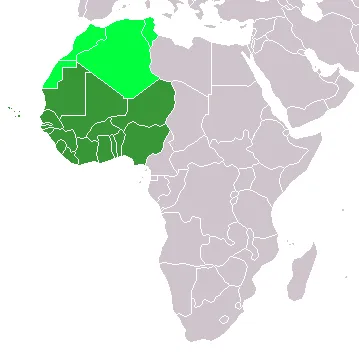
The history of West Africa has been divided into its prehistory, the Iron Age in Africa, the period of major polities flourishing, the colonial period, and finally the post-independence era, in which the current nations were formed. West Africa is west of an imagined north–south axis lying close to 10° east longitude, bordered by the Atlantic Ocean and Sahara Desert. Colonial boundaries are reflected in the modern boundaries between contemporary West African states, cutting across ethnic and cultural lines, often dividing single ethnic groups between two or more states. West African populations were considerably mobile and interacted with one another throughout the population history of West Africa. Acheulean tool-using archaic humans may have dwelled throughout West Africa since at least between 780,000 BP and 126,000 BP (Middle Pleistocene). During the Pleistocene, Middle Stone Age peoples (e.g., Iwo Eleru people, possibly Aterians), who dwelled throughout West Africa between MIS 4 and MIS 2, were gradually replaced by incoming Late Stone Age peoples, who migrated into West Africa as an increase in humid conditions resulted in the subsequent expansion of the West African forest. West African hunter-gatherers occupied western Central Africa (e.g., Shum Laka) earlier than 32,000 BP, dwelled throughout coastal West Africa by 12,000 BP, migrated northward between 12,000 BP and 8000 BP as far as Mali, Burkina Faso, and Mauritania, and persisted as late as 1000 BP or some period of time after 1500 CE. After the Kel Essuf Period, Round Head Period, and Pastoral Period of the Central Sahara, sedentary farming developed in West Africa among the ancestors of modern West Africans. The Iron industry, in both smelting and forging for tools and weapons, emerged in West Africa as early as 2631 BCE, and by 400 BCE, contact had been made with the Mediterranean civilizations, and a regular trade included exporting gold, cotton, metal, and leather in exchange for copper, horses, salt, textiles, beads, and slaves. The Tichitt culture developed in 2200 BCE and lasted until around 200 BCE. The Nok culture developed in 1500 BCE and vanished under unknown circumstances around 500 CE. Serer people constructed the Senegambian stone circles between 3rd century BCE and 16th century CE.
Also on this shelf
1676.
321.
See also
Uncatalogued shelfText from Wikipedia; plate via Wikimedia Commons. Text CC BY-SA 4.0; plate freely licensed (see Commons). Source record. Images and catalogue data are reproduced from open-access collections.