African Art
East–West Schism
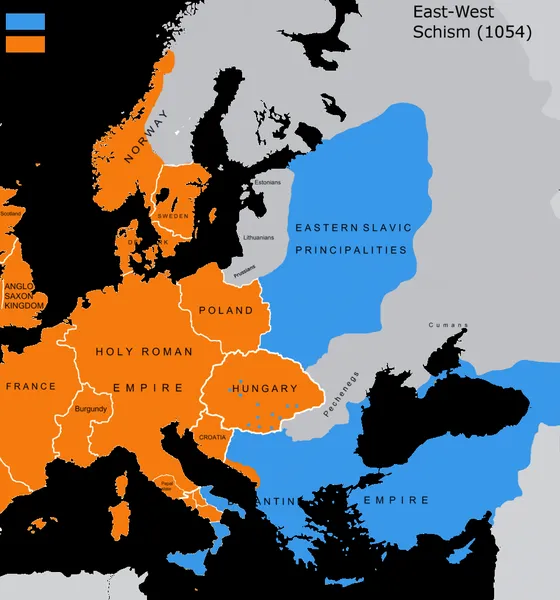
The East–West Schism, also known as the Great Schism or the Schism of 1054, is the break of communion between the Catholic Church and the Eastern Orthodox Church since 1054. A series of ecclesiastical differences, theological disputes and geopolitical tensions between the Greek East and Latin West preceded the formal split in 1054. Prominent among these were the Filioque clause of the Nicene Creed, whether leavened or unleavened bread should be used in the Eucharist, iconoclasm, the coronation of Charlemagne as emperor of the Romans in 800, the pope's claim to universal jurisdiction, and the place of the See of Constantinople in relation to the pentarchy. Although 1054 has become conventional, various scholars have proposed different dates for the Great Schism, including 1009, 1204, 1277, and 1484. The first action that led to a formal schism occurred in 1053 when Patriarch Michael I Cerularius of Constantinople ordered the closure of all Latin churches in Constantinople. In 1054, the papal legate sent by Leo IX travelled to Constantinople to deny Cerularius the title of "ecumenical patriarch" and insist that he recognize the pope's claim to be the head of all of the churches, and to seek help from the Byzantine emperor, Constantine IX Monomachos, in view of the Norman conquest of southern Italy, and to respond to Leo of Ohrid's attacks on the use of unleavened bread and other Western customs, attacks that had the support of Cerularius. When the leader of the legation, Cardinal Humbert of Silva Candida, learned that Cerularius had refused to accept the demand, he excommunicated him, and in response Cerularius excommunicated Humbert and the other legates. The validity of the Western legates' act is doubtful because Pope Leo had died and Cerularius' excommunication only applied to the legates personally. Still, the Church split along doctrinal, theological, linguistic, political, and geographical lines, and the fundamental breach has never been healed: each side occasionally accuses the other of committing heresy and of having initiated the schism. Reconciliation was made increasingly difficult in the generations that followed; events such as the Latin-led Crusades, though originally intended to aid the Eastern Church, only served to further tension.
Also on this shelf
1606.
2 euro commemorative coins.
See also
Uncatalogued shelfText from Wikipedia; plate via Wikimedia Commons. Text CC BY-SA 4.0; plate freely licensed (see Commons). Source record. Images and catalogue data are reproduced from open-access collections.