African Art
Nok culture
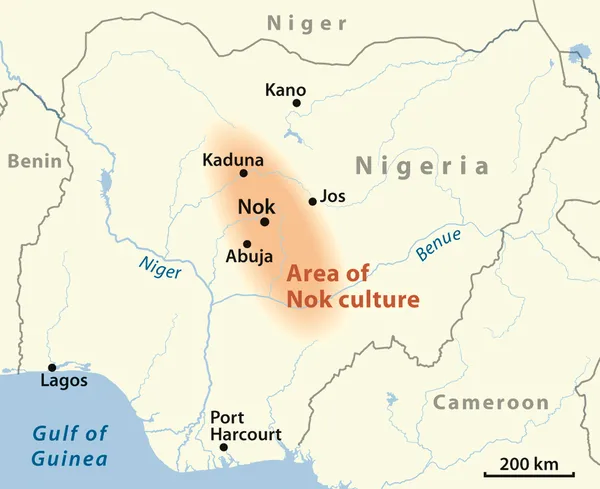
The Nok culture is a population whose material remains are named after the Ham village of Nok in southern Kaduna State of Nigeria, where their terracotta sculptures were first discovered in 1928. The Nok people and the Gajiganna people may have migrated from the Central Sahara, along with pearl millet and pottery, and diverged prior to arriving in the northern region of modern-day Nigeria. This may have led to their respective settlements in the regions of Gajiganna and Nok. Nok people may have also migrated from the West African Sahel to the region of Nok. Nok culture may have emerged in 1500 BCE and continued to persist until 1 BCE. Nok people may have developed terracotta sculptures, through large-scale economic production, as part of a complex funerary culture that may have included practices such as feasting. The earliest Nok terracotta sculptures may have developed in 900 BCE. Some Nok terracotta sculptures portray figures wielding slingshots, as well as bows and arrows, which may be indicative of Nok people engaging in the hunting, or trapping, of undomesticated animals. A Nok sculpture portrays two individuals, along with their goods, in a dugout canoe. Both of the anthropomorphic figures in the watercraft are paddling. The Nok terracotta depiction of a dugout canoe may indicate that Nok people used dugout canoes to transport cargo, along tributaries (e.g., Gurara River) of the Niger River, and exchanged them in a regional trade network. The Nok terracotta depiction of a figure with a seashell on its head may indicate that the span of these riverine trade routes may have extended to the Atlantic coast. In the maritime history of Africa, there is the earlier Dufuna canoe, which was constructed approximately 8000 years ago in the northern region of Nigeria; as the second earliest form of water vessel known in Sub-Saharan Africa, the Nok terracotta depiction of a dugout canoe was created in the central region of Nigeria during the first millennium BCE. As part of Nok traditional medicine, Nok ceramics may have been used to process roots and bark as medicinal plants for the production of medicinal decoctions. Excluding ancient Egyptian figurative art, Nok sculptures are regarded to be the earliest examples of large three-dimensional (sculptural) figurative art in continental Africa.
Also on this shelf
1804.
1984.
See also
Uncatalogued shelfText from Wikipedia; plate via Wikimedia Commons. Text CC BY-SA 4.0; plate freely licensed (see Commons). Source record. Images and catalogue data are reproduced from open-access collections.