African Art
Buddhas of Bamiyan
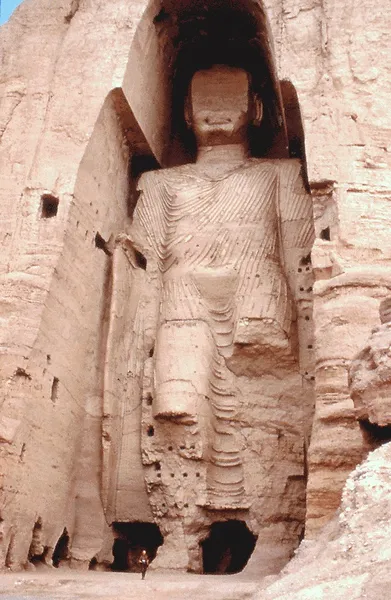
The Buddhas of Bamiyan (Dari: تندیسهای بودا در بامیان) were two monumental Buddhist reliefs in the Bamiyan Valley of Afghanistan, carved possibly around the 6th-century. Located 130 kilometres (81 mi) to the northwest of Kabul, at an elevation of 2,500 metres (8,200 ft), carbon dating of the structural components of the Buddhas has determined the smaller 38 m (125 ft) "Eastern Buddha" was built around 570 CE, and the larger 55 m (180 ft) "Western Buddha" was built around 618 CE, which would date both to the time when the Hephthalites ruled the region. In March 2001, both structures were destroyed by the Taliban following an order given on February 26, 2001, by Taliban leader Mullah Muhammad Omar, to destroy all the statues in Afghanistan "so no one can worship or respect them in the future". International and local opinion condemned the destruction of the Buddhas. Inscribed in 2003 as part of a UNESCO World Heritage Site, the Buddhas are recognized as an outstanding expression of Gandharan Buddhism. In the meantime, the Taliban conducted several days of massacre of the Hazaras − a regional ethnic minority − going door to door, killing men, women, and children. Homes, markets, trees, graveyards, and other cultural sites of Hazaras were all destroyed. Hazara community leaders later claimed that as many as 15,000 people were massacred by the Taliban. The sculptures represented a later evolution of the classic blended style of Greco-Buddhist art at Gandhara. The larger structure was named "Salsal" ("the light shines through the universe") and was referred as a male. The smaller relief is called "Shah Mama" ("Queen Mother") and is considered as a female figure, but this cannot be said with certainty. The smaller statue predated the larger one. Technically, both were reliefs: at the rear, they each merged into the cliff wall. The main bodies were hewn directly from the sandstone cliffs, but details were modeled in mud mixed with straw, coated with stucco. This coating, the majority of which wore away long ago, was painted to enhance the expressions of the faces, hands, and folds of the robes; the larger one was painted carmine red, and the smaller one was painted multiple colours. The lower parts of the sculptures' arms were constructed from the same mud-straw mix, supported on wooden armatures.
Also on this shelf
1814.
Decimal separator.
See also
Uncatalogued shelfText from Wikipedia; plate via Wikimedia Commons. Text CC BY-SA 4.0; plate freely licensed (see Commons). Source record. Images and catalogue data are reproduced from open-access collections.