African Art
Art Nouveau in Milan
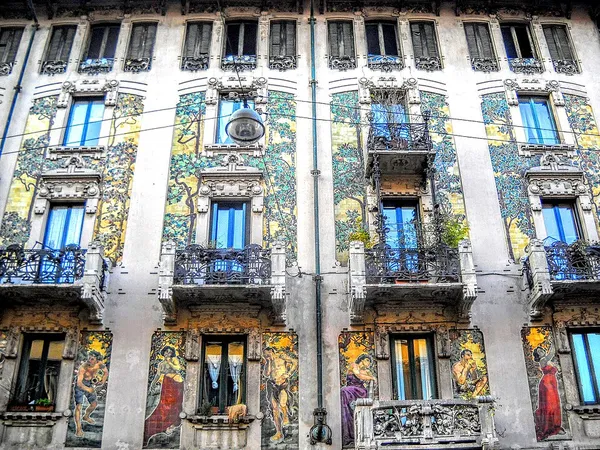
Art Nouveau in Milan indicates the spread of such artistic style in the city of Milan between the early years of the 20th century and the outbreak of the First World War. In the Lombard capital, art nouveau, called Stile Liberty in Italian, found—thanks to its close relationship with the rampant industrial bourgeoisie of the time—a fertile ground for its rapid development, during which it oscillated between the influences of French Art Nouveau, German Jugendstil and eclecticism. At the beginning of the 20th century the Milanese bourgeois class, formed as a result of industrialization and already becoming masters of the social and economic life of the city, found in the new liberty style a "symbol of status" and the occasion to show its power and at the same time underline the clear departure from the noble class and its neoclassical and baroque residences. The Milan International world's fair of 1906 gave further impetus to the development of liberty, as dozens of pavilions and numerous public buildings were built in this style, which decreed the definitive consecration of liberty as the dominant artistic style in the city. Reaching its peak in 1906, Milanese liberty experienced the first contaminations with eclectic architecture, which became stronger and stronger until the years of World War I, after which the liberty survived only with minor influences on minor architecture, while the taste of the industrial bourgeoisie converged spontaneously towards art deco. The Milan Central Station, built from 1924 in a late-eclectic style with Art Deco decorations and modernist influences, is considered by Gualdoni and Melano the conclusion of art nouveau in Milan, which made room for art deco and Italian Novecento. The Milanese stage of the liberty style was inaugurated with the construction of the Palazzo Castiglioni, completed in 1903 according to the project of Giuseppe Sommaruga, who would become, according to Sacerdoti, the most prominent interpreter of Milanese art nouveau. Alongside traditional sculpture in marble and stone, art nouveau brought about a great development of sculpture in wrought iron and cement. According to Ogliari and Bagnera, wrought iron found its best interpreter in Alessandro Mazzucotelli, who elevated the working of this material from a simple decorative element to a true art.
Also on this shelf
1882.
1611.
See also
Uncatalogued shelfText from Wikipedia; plate via Wikimedia Commons. Text CC BY-SA 4.0; plate freely licensed (see Commons). Source record. Images and catalogue data are reproduced from open-access collections.