African Art
Ancient Greek art
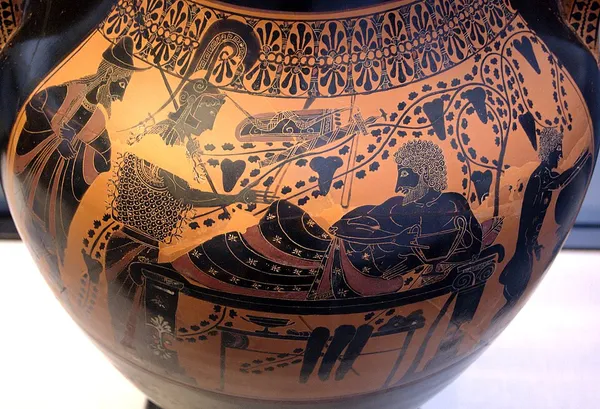
Ancient Greek art is the visual and applied arts, as well as the architecture, produced by the Hellenes or Greek peoples from the start of the Iron Age to the Hellenistic period, ending with Roman conquest of Greece at the Battle of Corinth in 146 BC. It stands out among that of other ancient cultures for its development of naturalistic but idealized depictions of the human body, in which largely nude male figures were generally the focus of innovation. The rate of stylistic development between about 750 and 300 BC was remarkable by ancient standards, and in surviving works is best seen in sculpture. There were important innovations in painting, which have to be essentially reconstructed due to the lack of original survivals of quality, other than the distinct field of painted pottery. Greek architecture, technically very simple, established a harmonious style with numerous detailed conventions that were largely adopted by Roman architecture and are still followed in some modern buildings. It used a vocabulary of ornament that was shared with pottery, metalwork and other media, and had an enormous influence on Eurasian art, especially after Buddhism carried it beyond the expanded Greek world created by Alexander the Great. The social context of Greek art included radical political developments and a great increase in prosperity; the equally impressive Greek achievements in philosophy, literature and other fields are well known. The earliest art by Greeks is generally excluded from "ancient Greek art", and instead known as Greek Neolithic art followed by Aegean art; the latter includes Cycladic art and the art of the Minoan and Mycenaean cultures from the Greek Bronze Age. The art of ancient Greece is usually divided stylistically into four periods: the Geometric, Archaic, Classical, and Hellenistic. The Geometric age is usually dated from about 1000 BC, although in reality little is known about art in Greece during the preceding 200 years, traditionally known as the Greek Dark Ages. The 7th century BC witnessed the slow development of the Archaic style as exemplified by the black-figure style of vase painting.
Also on this shelf
1835.
1518.
See also
Uncatalogued shelfText from Wikipedia; plate via Wikimedia Commons. Text CC BY-SA 4.0; plate freely licensed (see Commons). Source record. Images and catalogue data are reproduced from open-access collections.