African Art
Dionysus
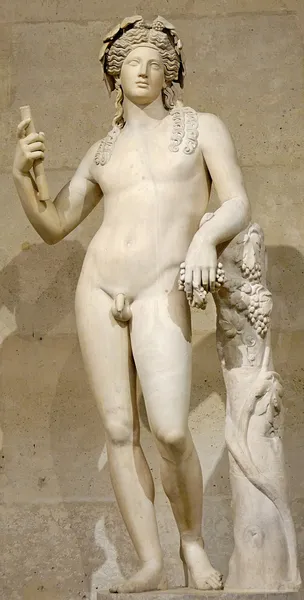
In ancient Greek religion and myth, Dionysus ( ; Ancient Greek: Διόνυσος Diónysos) is the god of wine-making, orchards, fruit, vegetation, fertility, festivity, insanity, ritual madness, religious ecstasy, and theatre. He was also known as Bacchus ( or ; Ancient Greek: Βάκχος Bacchos) by the Greeks (a name later adopted by the Romans) for a frenzy he is said to induce called baccheia. His wine, music, and ecstatic dance were considered to free his followers from self-conscious fear and care, and subvert the oppressive restraints of the powerful. His thyrsus, a fennel-stem sceptre, sometimes wound with ivy and dripping with honey, is both a beneficent wand and a weapon used to destroy those who oppose his cult and the freedoms he represents. Those who partook of his mysteries were believed to become possessed and empowered by the god himself. His origins are uncertain, and his cults took many forms. Traditionally the cult of Dionysus has been said to have originated from Asia Minor and introduced to the Greeks via Thrace. But, his name is mentioned in Linear B tablets from Pylos; so, he might be of Mycenaean origin. In Orphism, he was variously a son of Zeus and Persephone; a chthonic or underworld aspect of Zeus; or the twice-born son of Zeus and the mortal Semele. The Eleusinian Mysteries identify him with Iacchus, the son or husband of Demeter. Most accounts say he was born in Thrace, traveled abroad, and arrived in Greece as a foreigner. His attribute of "foreignness" as an arriving outsider-god may be inherent and essential to his cults, as he is a god of epiphany, sometimes called "the god who comes". Wine was a religious focus in the cult of Dionysus and was his earthly incarnation. Wine could ease suffering, bring joy, and inspire divine madness. Festivals of Dionysus included the performance of sacred dramas enacting his myths, the initial driving force behind the development of theatre in Western culture. The cult of Dionysus is also a "cult of the souls"; his maenads feed the dead through blood-offerings, and he acts as a divine communicant between the living and the dead. He is sometimes categorised as a dying-and-rising god.
Also on this shelf
Chiapas.
1587.
See also
Uncatalogued shelfText from Wikipedia; plate via Wikimedia Commons. Text CC BY-SA 4.0; plate freely licensed (see Commons). Source record. Images and catalogue data are reproduced from open-access collections.